

本站推荐电影
-
·震有科技:全球卫星主要的发展方向是低轨卫星互联网
·鲁比奥称美国暂不计划对伊朗发动新一轮打击
·Ethiopia Denies Sudanese Claims it Executed Seven Soldiers as Khartoum Withdraws Envoy
·「今こんなに髪短いの!?」右腕タトゥーも写り込み…あいみょん、ベリーショート姿の近影公開に驚きの声
·India pledges to help revive SL tourism
·“简拉维”刚走“沙德尔”接棒 周五对杭州影响最明显
·天佑德酒:上半年净利润1044.01万元,同比下降79.71%
·海底捞二代浮出水面 张勇28岁儿子悄然入场 没头衔却手握业务话语权
·15分钟20炸!9层大楼被捅穿,苏35悍然闯线,基辅这次真顶不住了,兵器志,原创 15分钟20炸!9层大楼被捅穿,苏35悍然闯线,基辅这次真顶不住了
·New Row as NHS Erases 'Women' From Menopause Web Page
·国家防总、应急管理部组织多部门联合会商,调度部署台风“沙德尔”防范应对工作
·Rivian聘请前Waymo高管负责新自动驾驶和人工智能业务
·VLC播放器将增加AirPlay支持,下载量近30亿次。
·地铁里,没有人穿高跟鞋了
·考一次试就能申请?新加坡低龄留学生申请PR都有哪些要求?
本站推荐电视剧
-
·投诉月亮太亮影响睡觉,专家:12345应实名制
·山东发布重点人才需求岗位 今年引才需求总量超十万人
·海南州:打造“新能源+算力”双向赋能特色产业集群
·疯了!疯了!不给钱也要打!这可是MVP球员,九届全明星啊!
·美国运营商被指控向第三方出售位置信息:每人4.95美元
·详解哈登3年9700万续约骑士:总薪资破5亿比肩詹杜库 招募沃特森冲冠
·台青来大陆,眼见才为实
·100만명 몰리는 불꽃축제…서울시 ‘명당 호텔’ 바가지요금 살핀다
·【研报观点】8月26日纸浆最新观点汇总
·Top anti-graft body vows more concrete measures
·A股午评:深证成指、创业板指涨超1%,有色·铜、证券、工业金属等概念走强
·600亿牛股“六个核桃”,直线跌停
·阿技寻花|爱了爱了~这身材也太夯了吧
·队记:杜锋朱芳雨换身份不是句号 将来还是存在分久必合的可能性
·乘坐这两趟火车的人员,请立即报备并核酸检测!
电影下载排行
-
·拼多多惠民车行质量问题
·黄仁勋的“达链”闭环了
·网易考拉重新发行,将前往加拿大鹅指定机构进行认证。
·施罗德谈频繁换队:这就是生意 拿钱生活照旧
·赵长江透露智界 V9 旗舰 MPV 明年可升级 L3,此前已官宣有硬件预埋
·欧冠新军沙巴巴库2017年才建队,连闯四轮资格赛晋级正赛
·每体:弗里克此前与泰尔齐奇仅有1次交手,拜仁让二追四击败多特
·科尔:火箭知道自身优势 他们大量使用亚当斯&有时祭出双塔
·元鉄工所勤務Hカップグラドル、衝撃的な曲線美露出「お尻が最高」バックショット「至高の領域」
·活力中国调研行|好客山东“上新”了
·福州发布暴雨黄色预警信号
·工程师分析 Win11 争议后台服务:用于性能诊断,含 84 个诊断脚本
·UK records a fourth death linked to a storm that battered northern Europe
·市场监管总局:累计实施质量攻关重点项目2060个
·【成长·传承】春龙抬头 “童”趣无限——青岛高新区实验幼儿园开展“二月二,龙抬头”活动
电视剧下载排行
-
·Lisa of BLACKPINK to Make Film Debut in Action Movie Extraction: Taigo
·Birkenstock goes public on New York Stock Exchange
·用暖心服务传递更多温度(人民满意的公务员)_山清_纳税人
·第十五周幼儿营养食谱
·绝区零蕾米埃尔/希格莉德4K动态壁纸,千千壁纸精选放送
·奋斗者“冀”语 | 乡村里的全天候“120”,40年扎根乡村守护5000多名乡亲们的健康
·“钰”见雄安Vlog | 送雄安一号上太空
·悬念再起!法国连扳三球3-4英格兰!
·从打球机器人,看Physical AI 的路线之争
·特朗普封杀黑利成为副总统搭档的可能性,美媒称拒绝黑利等于败选
·오세훈 "탄천물재생센터 구상 정식 제안…청년주택단지 가능"
·8月到10月拥车证配额增加 车行:咨询及买车人数增约三成
·Air raid warning alarm sounded across Ukraine
·向新逐梦写情怀
·一「指」爆红:斩获千万流量,这个WNBA球员只用了22秒
生活大爆炸第六季
-
发布时间:2026-08-26
我们来了
Florida men charged with kidnapping, waterboarding and torturing man in case of mistaken identity_我的网站

一 |
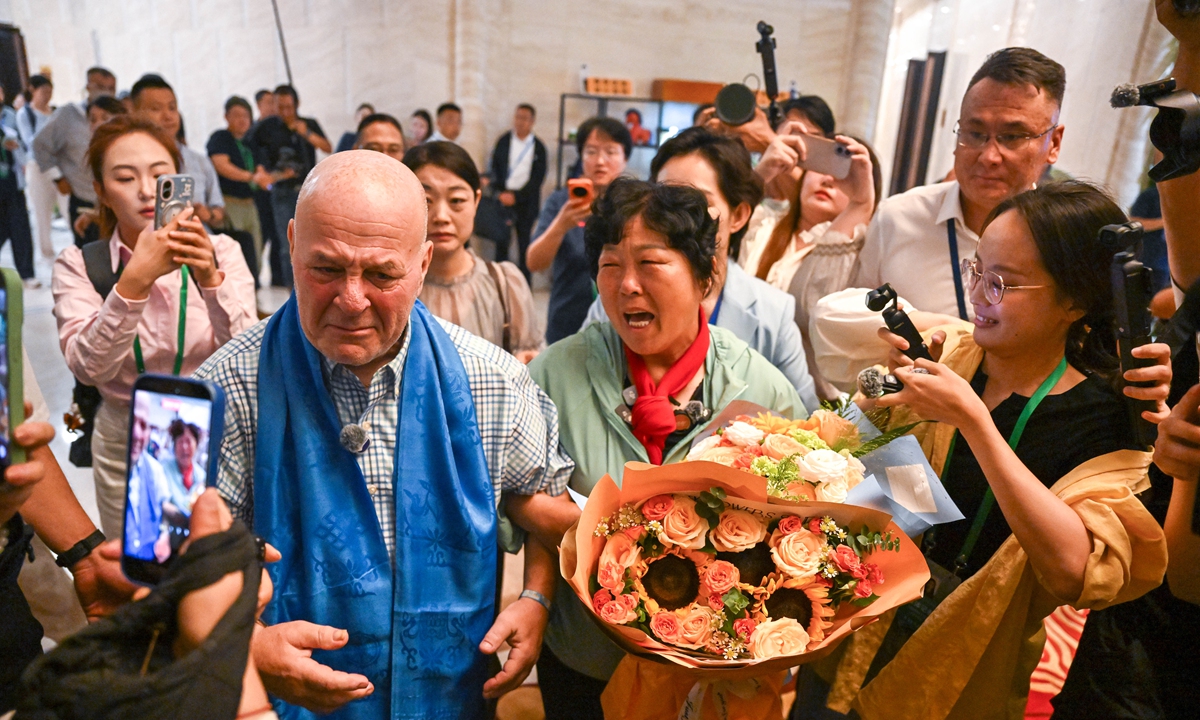
A long-awaited reunion that captured wide public attention unfolded on Sunday evening when American teacher Ronald Sakolsky and Yin Yuzhen, a model worker renowned for planting trees and combating desertification, reunited and embraced tearfully with overwhelming emotion at an airport in Ordos, North China's Inner Mongolia Autonomous Region, after 27 years of separation across the ocean.
The reunion began with a single act of generosity in 1999. When Sakolsky arrived in China as a participant in a China-US education exchange program, he was moved by Yin and her husband's tireless efforts to curb desertification in the Mu Us Desert in Inner Mongolia. He raised $5,000 to fund their local tree-planting initiative. The young saplings they bought with the donation have since matured into more than 50,000 full-grown trees, transforming the once desolate, sandy wasteland into a thriving green landscape.
This hug, transcending time and distance, marked not only friendship between the two countries, but also showcased the sincerity of Chinese people and a green miracle made possible through continuous joint efforts.
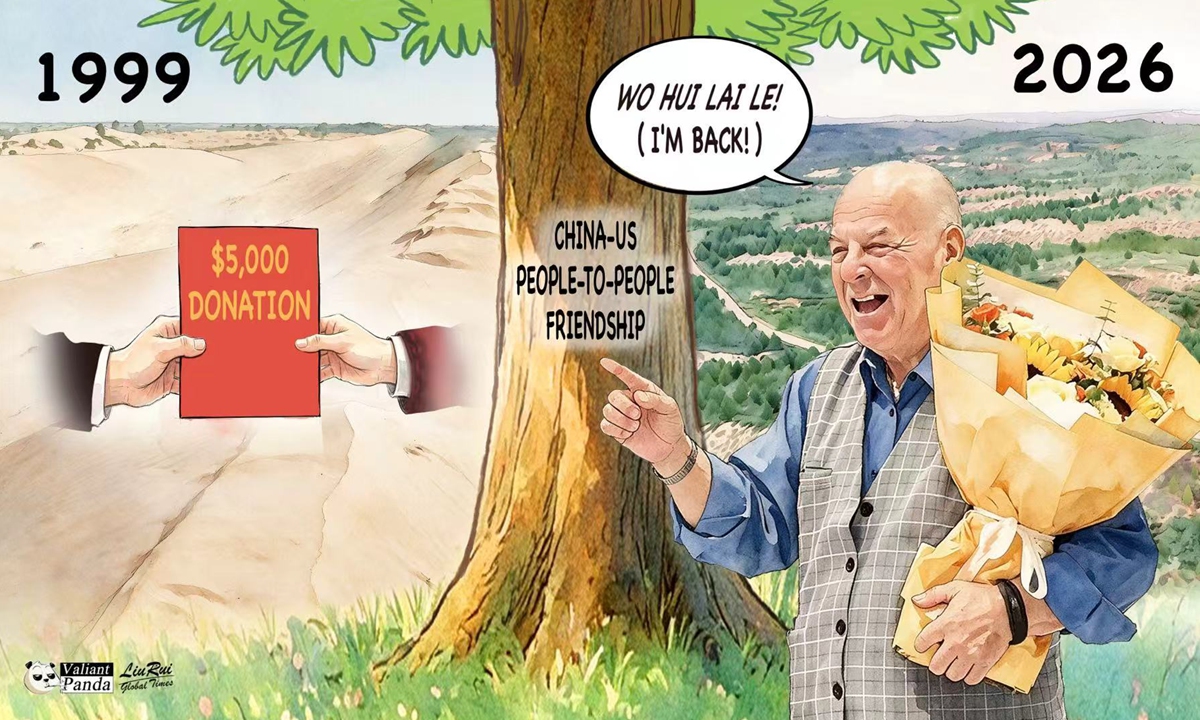
At 2:48 am on early Sunday morning, Ronald Sakolsky arrived at Beijing Capital International Airport after over 10 hours of flight. As he stepped into the arrivals hall, he greeted the waiting reporters with earnest Putonghua "Wo hui lai le," meaning "I'm back."
"When I saw the lights in Beijing as we were landing is when I realized that I am back in my second home."
Asked what he is most looking forward to about this journey, Sakolsky told the Global Times that "I want to see Ms Yin, see the forests, see the students I have not seen for almost 30 years, my colleagues. I want to see the Chinese people."
He then flew to Ordos for the meeting with his desert reclamation partner.
Yin waited at the arrival gate at the airport in Ordos very early, murmuring English sentence she particularly learned for this occasion - "Welcome to China, my brother." Her eyes were fixed on the escalator and she wiped away her tears multiple times during the wait, the Global Times reporter observed.
Sakolsky said in earlier interview with the Global Times that he was looking forward to this reunion and could not hold his tears back when he thought of the moment. He was about to give Yin a hug when they meet.
When Sakolsky finally appeared in front of Yin, their eyes welled up. Stepping off the elevator, Sakolsky could barely contain his excitement, muttering "Oh my God, oh my God." They hurried toward each other and locked in a tight embrace at last - the long-awaited hug 27 years in the making.
"This is a dream come true, from a lady who is the hero of the story, not me," Sakolsky told the Global Times at the airport, barely holding his emotion. "She made a promise 27 years ago, and she kept her promise."
Talking about his donation almost three decades ago, Sakolsky said the purpose was to help her, "because she was beautifying the motherland."
Now, in response to an invitation to return to China for a trip to see the green planting from his donation and to returning to the city of Luoyang, Central China's Henan Province, where he taught in the exchange program for several years, Sakolsky noted that "China had done so much for me that I wanted to say thank you to China."
A return of kindness
For this reunion after 27 years, Yin had carefully prepared. Steamed buns, meaning "upward," fresh vegetables and fruits picked in the land transformed from desert.
Yin, never familiar with any foreign language, learned some English phrases, including "welcome to China" she practiced, "my brother" to greet Sakolsky, and "more, more" to persuade the American friend to eat more.
On Sunday, Yin did her hair and wore a red scarf alongside an outfit with a green shade, which she picked particularly for the reunion, as "green is the color of the Earth," as she told the Global Times.
Yin is not the only old friend that was looking forward to the reunion.
While Sakolsky was still on his over-10-hour flight from the US to Beijing, Bai Fan was also on the way - driving over 850 kilometers from Luoyang to Inner Mongolia. The journey would take a day and a half.
Bai was the vice principal of Luoyang Foreign Language School, overseeing international affairs. Sakolsky was an exchange teacher there through a China-US program, and was Bai's "neighbor right across the hall."
Why drive such a distance? Bai had prepared special cultural gifts - peony porcelain and Hanguan Kiln purple clay tea ware, distinctive local handicrafts that proved too bulky and fragile for air travel or high-speed rail.
Bai recalled Sakolsky's continuous interest in Chinese culture, and sending a replica of Terracotta Warriors to the US at Sakolsky's request. "I hope he can take these Luoyang elements and Chinese symbols to the world," Bai told the Global Times in a phone interview on Sunday.
Bai is also eager to see Sakolsky at a place that they had traveled together 27 years ago. When Sakolsky came to Luoyang for the exchange program, Bai was his designated liaison. Together, they traveled to the heart of the Mu Us Desert to deliver the $5,000 donation.
Bai still vividly remembers the desolate desert back then, where finger-thin saplings were watered ladle by ladle by Yin. At that time, Sakolsky had constant concerns about whether the tiny saplings could survive in the wasteland, which makes today's sprawling 50,000-tree forest even more miraculous.
The changed and unchanged
Things have changed over the past 27 years. While waiting for Sakolsky, Yin jokingly said he got less hair, and she would not be able to recognize him if running up to him on street.
The passage of time has brought far more than personal aging, according to Bai, another witness to the decades-long changes. "Everyone is growing older. Our families have expanded with more children, local communities have grown in population, and the surrounding environment is constantly evolving, just as our cities are undergoing profound transformations."
On a night tour in Ordos on Sunday, Sakolsky, watching a fountain light show, said that "it is a 21st century city, but it looks like a 22nd century city. In the 2000s, Chinese government made a promise to Chinese people to beatify this country, and they succeeded."
For Sakolsky, probably the most profound transformation lies in the depth of his human connection forged.
"27 years ago, we were just friends and acquaintances. We are brother and sister now. So much has happened since then, but the important thing is many people have seen the story and now they can also help to make China beautiful," he told the reporters.
Through joint efforts of people like Yin, the Mu Us Desert has turned from wasteland into a green oasis. China has contributed about 25 percent of the world's newly added green areas and taken the lead in achieving zero growth in land degradation, per official data.
Meanwhile, there are things unchanged, including a vintage photo of the three standing in the desert that has decorated Bai's office through all these years - a permanent reminder of their original aspiration.
This reunion will witness them retake the classic photo and plant new saplings together, expanding their green mission.
。 Two Florida brothers and another man were charged with federal kidnapping, waterboarding, and torturing a man despite knowing he was not the target of their plot, according to court documents unsealed on Tuesday.A man came out of his house on Oct. 13 in Plantation, Florida, and went into his apartment's parking garage between 7:30 and 8 a.m. when he was approached by three men, later identified as Jeffry Arista, Jonathan Arista, and Raymond Gomez, who brandished a firearm and told him to get in a black car with police lights, the complaint said."Jeffry Arista asked the victim to identify himself, implying they had kidnapped the wrong individual. The kidnappers further confirmed this when they removed the victim's wallet from his pocket and checked his identification. At this point, the kidnappers began inquiring why the coworker was using the victim's car this past Thursday and demanded to know where the money was," the criminal complaint, unsealed in the Southern District of Florida, said."The money was in reference to what the coworker allegedly owed the kidnappers. The kidnappers threatened the victim by putting an electric drill to his skin and pointing firearms towards his head," the complaint continued.The apartment the men allegedly brought the victim to was an Airbnb and at one point, the men brought the victim into the bathroom, laid him down, and poured water on his head -- "effectively waterboarding him," the complaint alleged.When they figured out it was in fact the wrong person, the men then allegedly "brainstormed" on how to get the correct person to them, which involved the victim being forced to call the correct target and make plans with him, according to the complaint.In order to solicit a large police presence, the victim went into his coworker's business on Oct. 14 and said he had a bomb, the complaint alleged. When law enforcement showed up, one of the alleged kidnappers was in the distance filming the victim, and the victim pointed out to law enforcement he was the one who allegedly kidnapped him.Law enforcement kept investigating the incident and Gomez was later arrested after he allegedly admitted to kidnapping the wrong person.Jeffry Arista and Jonathan Arista had their initial appearances in federal court on kidnapping charges on Monday. Gomez has not yet had a court appearance.Lawyers for the men did not respond to ABC News' request for comment.。
Current article:http://u7tvq.laonenpeidiebenhuaiyunnangshi.cfd/news/20260826_2935800.html
Published on:19:16:23
下载地址2:点击进入迅雷高速下载 温馨提示:邀请好友一起下,可提高下载速度,若遇无法下载,可另选时间尝试或重装软件!
下载方法:安装软件后,点击即可下载,谢谢大家支持,欢迎每天来!